Why this exists
If you’re trying to learn Levantine Arabic — the colloquial Arabic actually spoken in Jordan, Syria, Lebanon, Palestine — you’ve probably already noticed that the world isn’t set up to help you.
Textbooks teach Modern Standard Arabic, not the dialect anyone actually speaks. AI drifts into MSA the moment you ask it for casual conversation. YouTube doesn’t know you want Levantine content until you’ve trained your algorithm with hundreds of likes. Native speakers code-switch when they talk to you — not maliciously, just naturally. Tutors are still using outdated textbooks. The apps you can find are either teaching tourist phrases or making you click through flashcards that feel like homework.
The gates to learning this language are closed. Not deliberately. Structurally. Nobody hands you a key.
I spent years trying to break through those gates on my own. I live in America. I have no Levantine speakers around me day-to-day. I’m Muslim, so I learned to read the Arabic script as a kid through the Quran — but knowing the letters doesn’t mean knowing how to speak. I couldn’t read script without diacritics. I couldn’t string a sentence together. I couldn’t find anything that sounded like the Arabic my friends actually spoke at home.
So I improvised. For years.
I prompted AI in increasingly desperate ways — “as if you were literally a commoner from Amman” — and watched it drift back toward MSA every time. I’d take whatever output it gave me, paste it into ElevenLabs to generate audio, and listen to the result on loop, hoping some of it would stick. I’d manually like Levantine content on YouTube and Instagram, training my algorithm by hand, week after week, until my feed started looking like the feed of someone living in Amman. I’d record myself speaking and corner native speakers with: “Be honest with me. What do I actually sound like? Tell me, can you tell I’m not from there? Why?” They were always too polite. They’d say my Arabic was good. I wanted to know what was wrong.
What I figured out, slowly, was a method. Not a curriculum. A way of approaching the language that, if I’d had it from day one, would’ve saved me years.
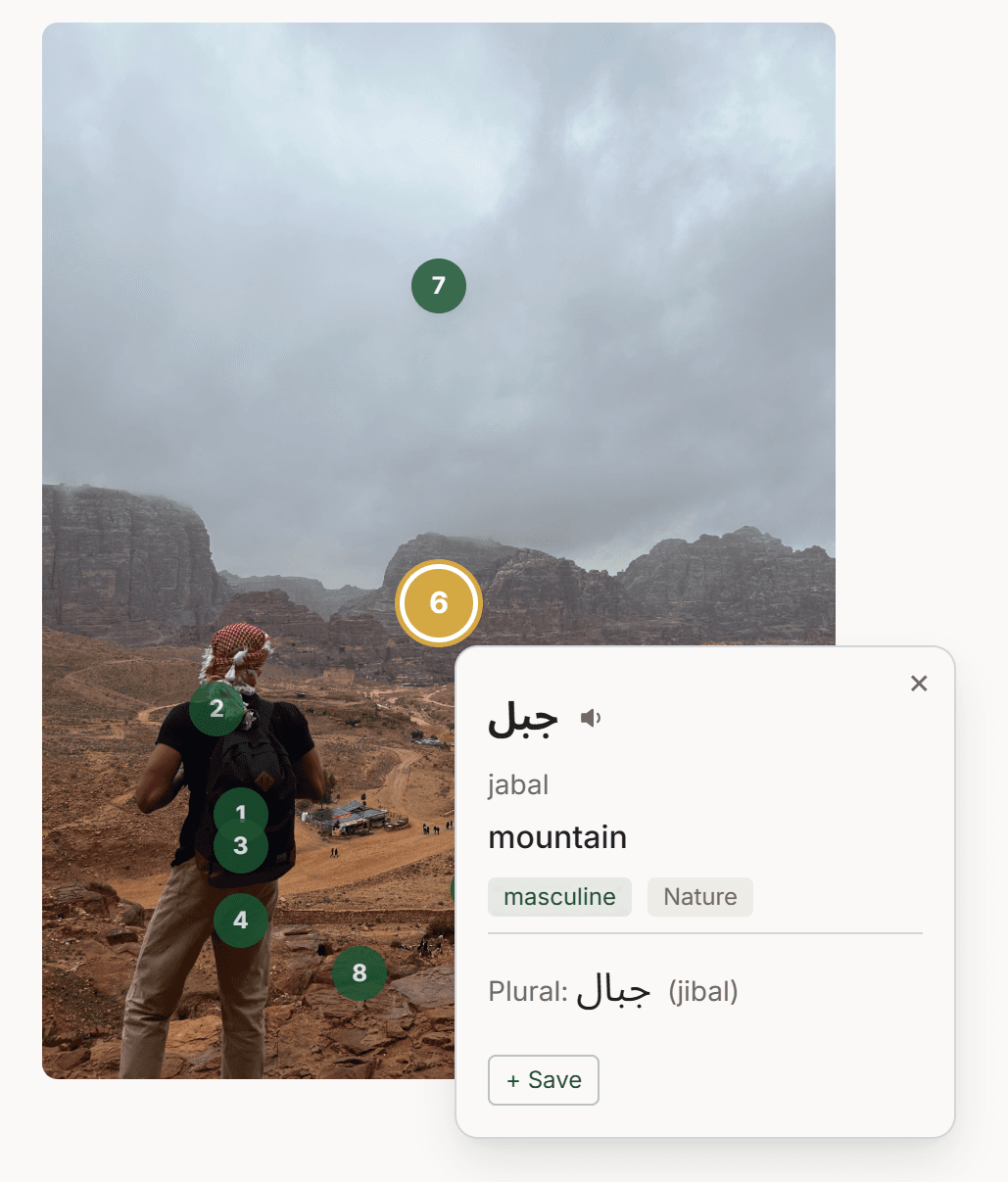
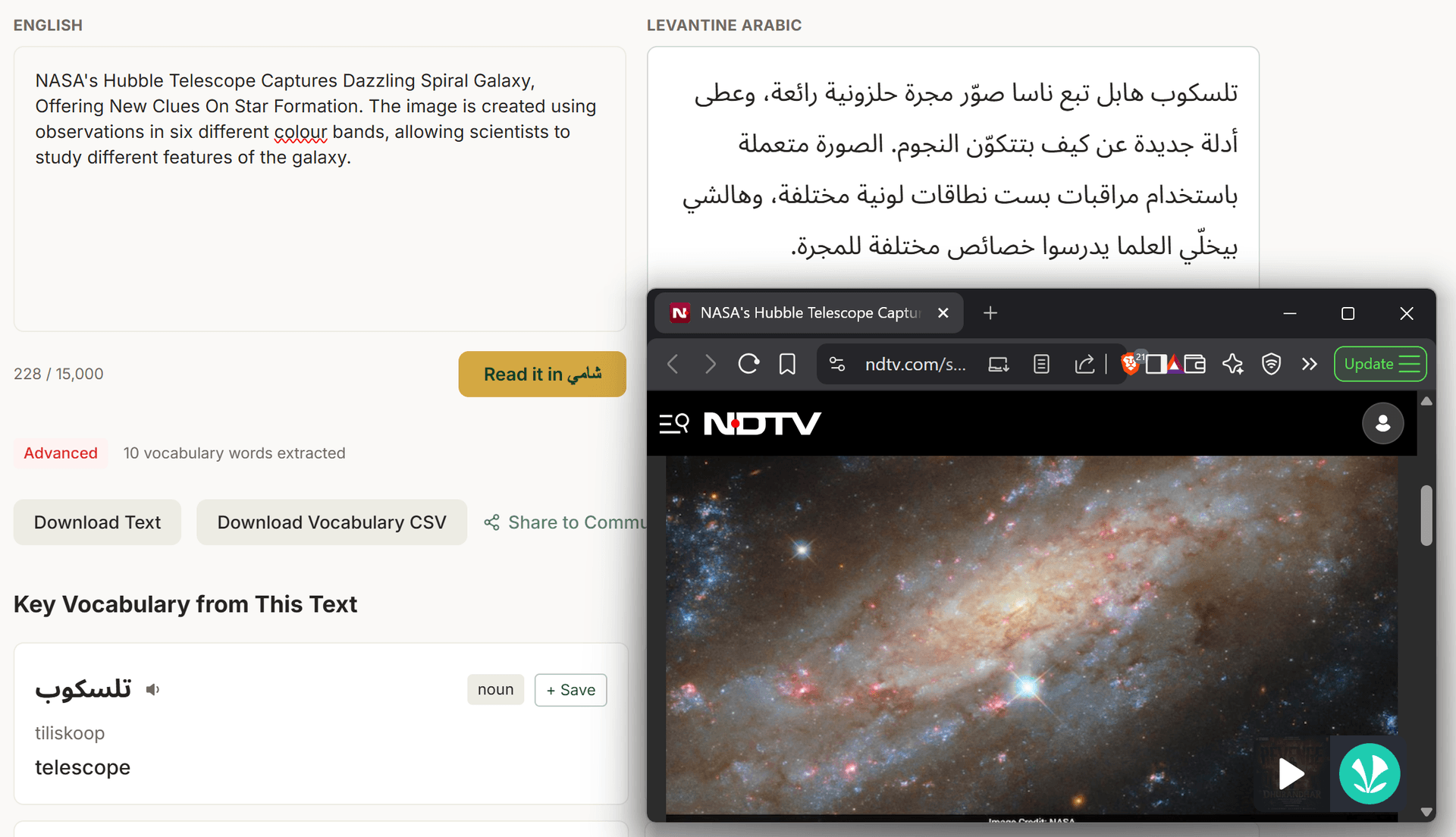
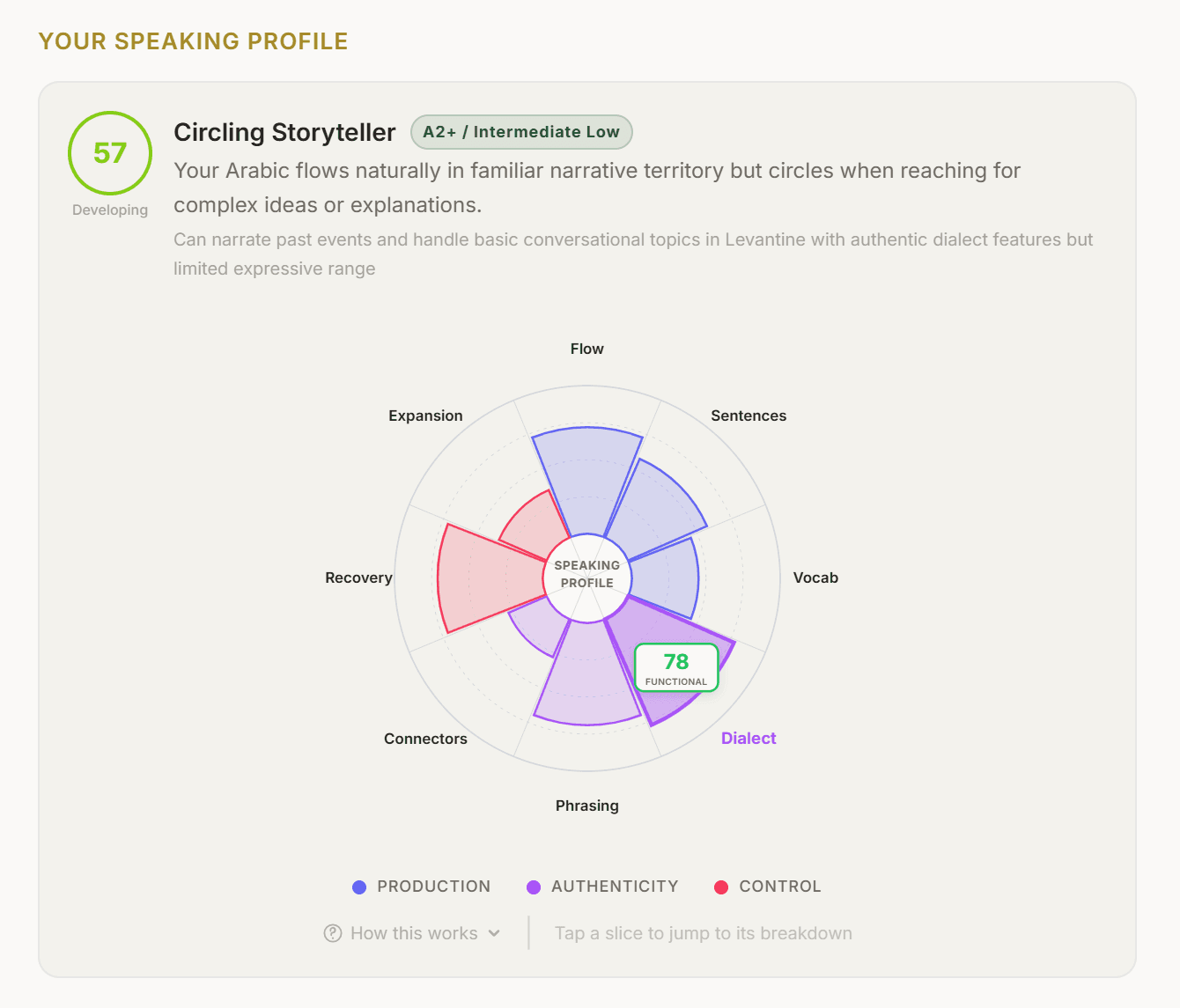
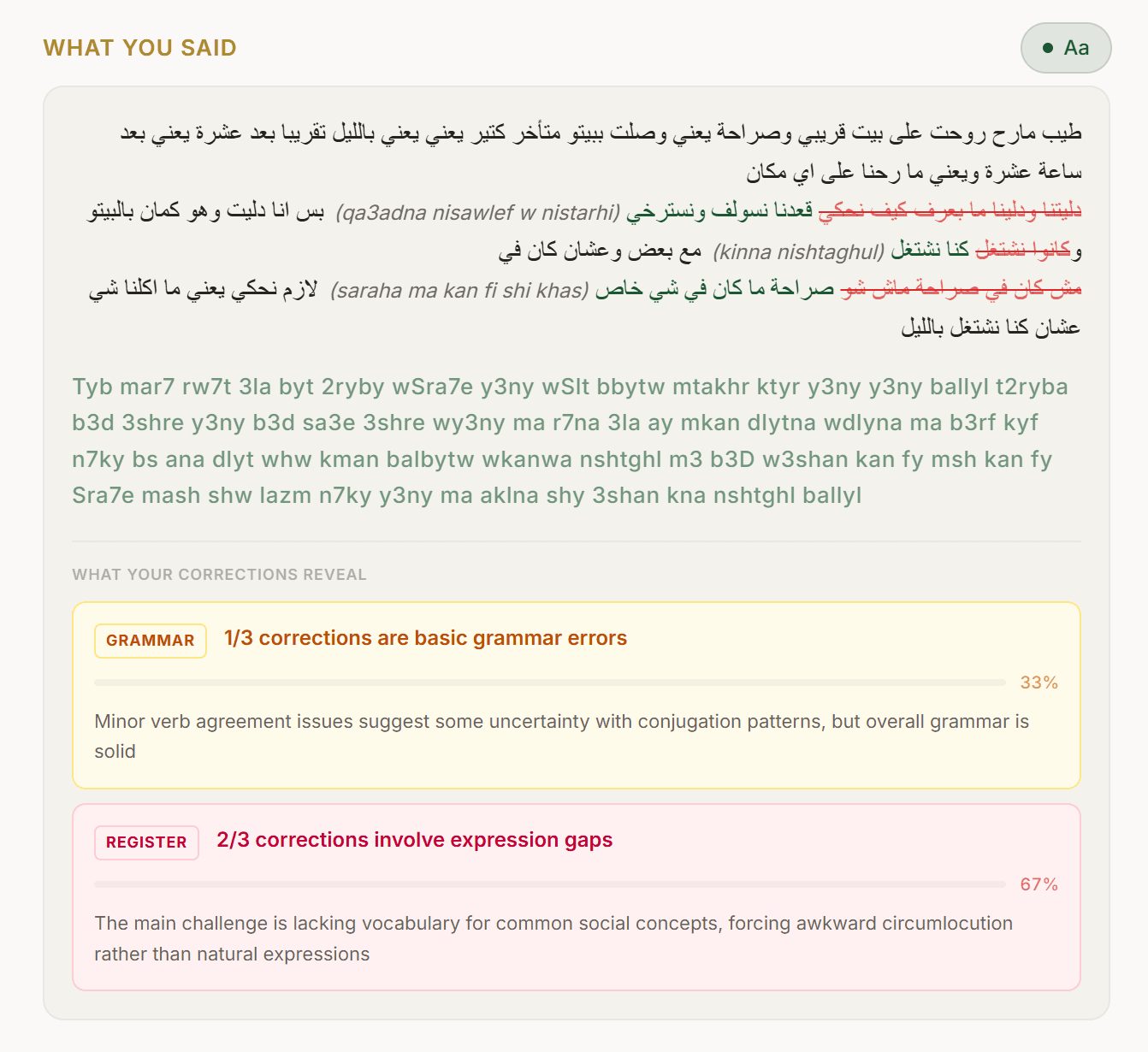
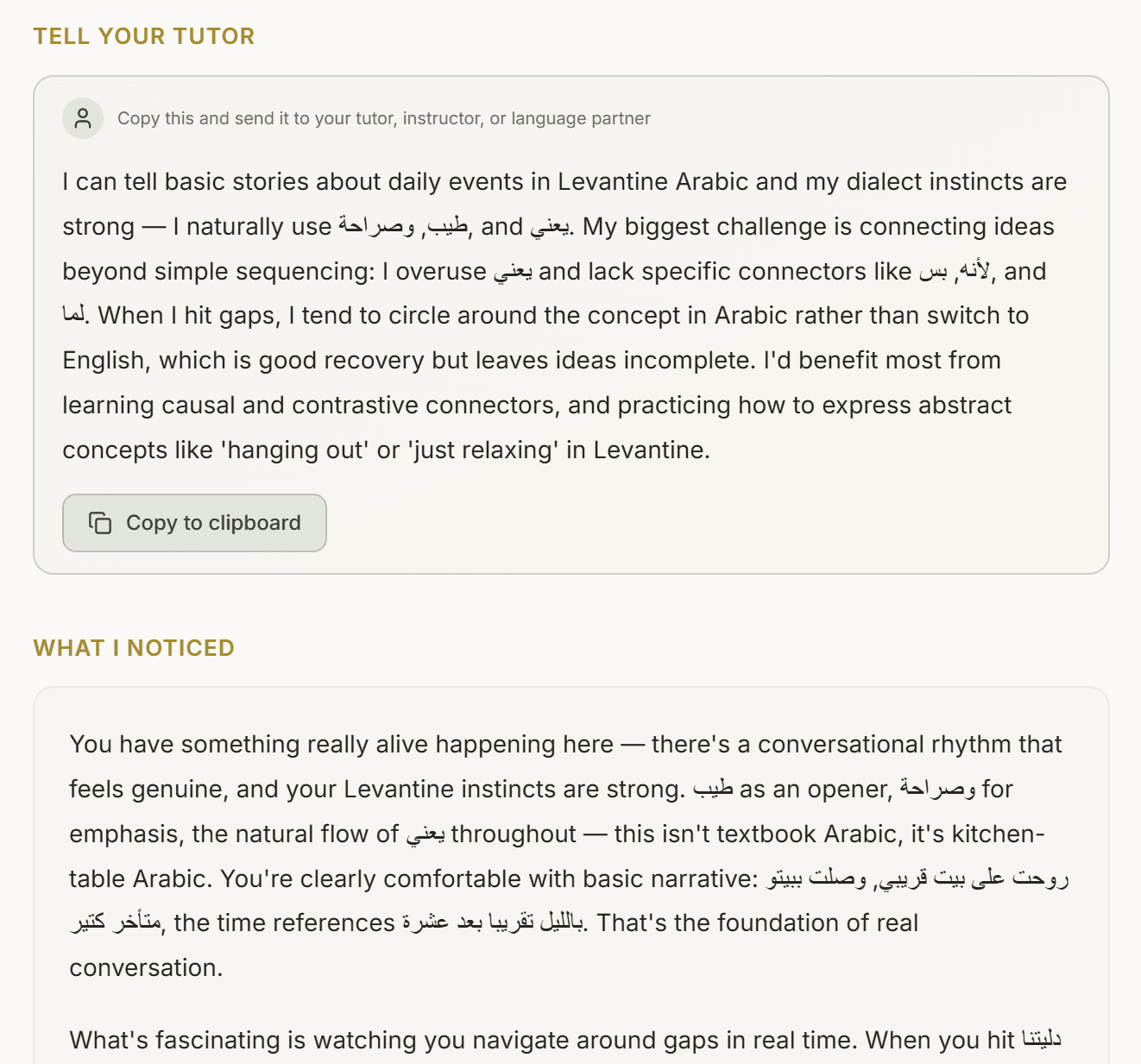
That method is what this product is. Every tool on this site is one button that automates something I used to do by hand. Image Lens is the Post-it-notes-on-everything trick, automated. Article Converter is “I used to beg AI for natural Levantine for hours,” automated. YouTube Finder is “I trained my algorithm by hand for years,” automated. Talk to Me is “I begged native speakers to honestly tell me what I sound like and they were always too polite,” automated.
I built it because I wished it had existed when I started. Now it does.
Every tool on this site is one button that automates something I used to do by hand.
This page is the theory. Not the tools — those are downstream. The theory is what makes the tools mean something. If you read just the tool pages, they’ll look interesting but disconnected. If you read this first, the tools turn into a path.
Who this is for
This applies to you whether you’re:
- An adult learner trying to actually speak Levantine. You’ve maybe tried Duolingo, maybe a textbook, maybe a tutor — and you can feel that none of them are getting you there.
- An Arab American who grew up hearing the dialect at home but never quite learned to speak it. You can understand more than you can produce.
- An MSA student who’s done the academic Arabic thing and now wants to actually communicate with people, not pass an exam.
- A complete beginner who knows nothing yet and is intimidated. Don’t be. The path is shorter than you think — if you know what to do.
- A parent who wants to teach your kids and has been struggling because immersion is hard to create at home when nobody around you speaks the language.
- A tutor or professor working with students using outdated materials, knowing your tools aren’t quite right but not having anything better.
The theory below applies to all of you. The tools serve all of you. The specifics differ — a parent uses Image Lens differently than an adult learner does — but the underlying method is the same.

The theory, in five parts
1. Immersion is not optional
Immersion is the single most important thing in dialect learning, and it’s the thing every other approach gets wrong.
If you live in America, you’re surrounded by English. Your phone speaks English to you. Your work is in English. Your friends are in English. There is no shortage of English in your life. You do not need more English. You need the opposite — you need a way to flood your environment with the language you’re trying to learn, even when you don’t understand any of it.
I used to put on Arabic podcasts when I went to sleep. I didn’t understand most of them. It didn’t matter. There was one specific podcast I listened to nearly a hundred times. It never got old, because every time I listened, I understood a tiny bit more than the time before. Comprehension grew not by sitting down to study, but by my ear getting trained, slowly, in the background of my life.
This is what Conversations is for. It’s not a database of dialogues to “study.” It’s audio you put on while you do dishes, while you commute, while you fall asleep. It’s beginner, intermediate, and advanced — and you can listen at any level. Even if you don’t understand it, listen. Especially if you don’t understand it. Train your ear to know what conversational Levantine sounds like, so that when the words start to land, your brain has the rhythm and the texture to attach them to.
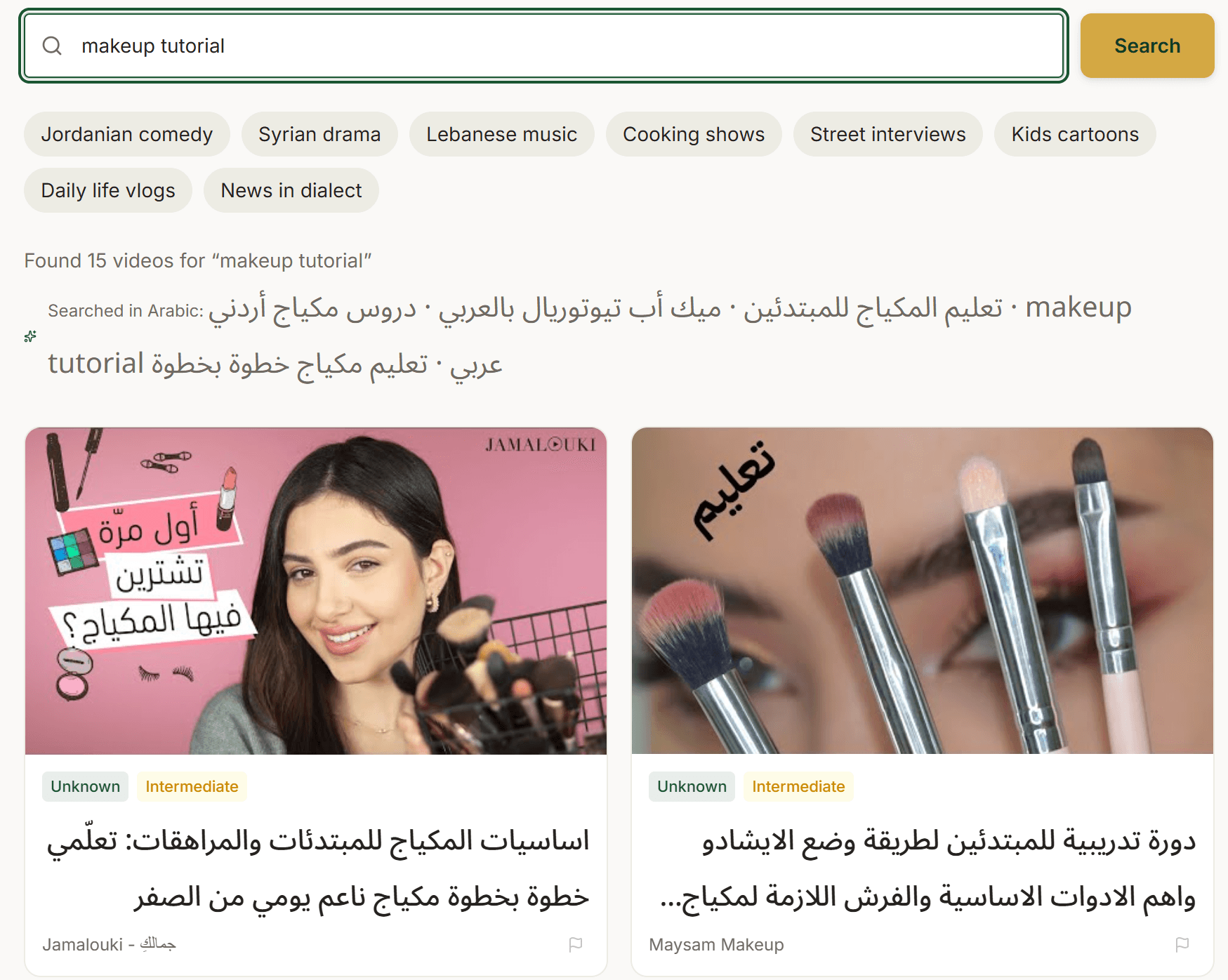
YouTube Finder is the same theory applied to video content. The reason your YouTube algorithm shows you English content is because that’s what you watch. The reason it doesn’t show you Levantine content is because Levantine content is hard to find, the algorithm doesn’t know to surface it, and you don’t know what to type in Arabic to find it. YouTube Finder is the search query I spent years figuring out, given to you in one button. Find Levantine creators, watch their content, train your algorithm. Pretend you’re a kid waking up in Amman every day.
There is no substitute for this. Apps that try to teach you dialect through clicking exercises are skipping the foundation. You don’t learn a language by clicking. You learn it by being in it.
2. Frequency is the curriculum
There’s a known principle in language learning: the most common 1,000 words in a language cover roughly 80% of everyday speech. Your textbook doesn’t tell you this. Your textbook gives you vocabulary by theme — “the family,” “the kitchen,” “transportation” — as if you’re going to learn this language by topic. You’re not. You’re going to learn it by frequency.
When I built the dictionary for Levantine Lens, I sorted it by how often each word appears across our 366-dialogue corpus. The most common word — يعني (“yaani”) — appears in 343 of those dialogues. That word alone is more useful to know than 50 textbook nouns about furniture.
Here’s what the corpus actually contains:
- 5,908 dictionary entries total, every single one tied to at least one real conversation
- 2,084 phrases (multi-word expressions, idioms, the way people actually speak)
- 1,456 nouns
- 1,008 verbs
- 667 adjectives
- 80 adverbs
- 30 pronouns, 15 prepositions, 9 particles, 3 conjunctions (the structural skeleton)
Frequency is the curriculum.
Now look at this and ask yourself: where do you spend your effort?
I’ll tell you where I spent mine, and what I learned.
Verbs first. This was the unlock for me. Verbs let you express anything if you can stitch them together — even if you have to fill in the noun in English while you’re learning. I can say I want to go to the “grocery store” and you’ll understand me, because the verb structure is doing the work. If I only know nouns, I’m stuck pointing.
Adjectives second. Adjectives let you have opinions, which is most of casual conversation. That’s expensive. This is good. He’s tired. I’m hungry. Once you have verbs and adjectives, you can communicate.
Nouns last. Nouns are easy to substitute. They’re also easy to absorb passively over time. You’ll pick them up. Don’t waste your early effort on them.
This is why Dictionary is sorted the way it is. It’s not alphabetical. It’s frequency-descending. The first words you see are the words you need first. Every entry shows you how many sources reference it — that’s not decoration, that’s the curriculum telling you what to prioritize.
Grammar Patterns works the same way. The most frequent pattern in Levantine — the بـ prefix for present tense — is the pattern at the top because it’s the pattern you’ll hear in literally every conversation. The future tense رح, the wanting structure بدي, the negation مش — they’re ranked by how often they actually occur. Learn them in that order and you’re learning the language by how the language is actually used, not how a textbook organizes it.
When I checked the data after building it and saw that my theory matched what the corpus showed, it was beautiful. The principle held.
3. Authentic dialect content is the bottleneck
Nobody writes in dialect. This is the central problem.
If you want to read in MSA, you have books, newspapers, websites, the Quran. Vast resources. If you want to read in Levantine — actual conversational Levantine, the way people text each other — there’s almost nothing. Native speakers write in MSA when they write at all. The dialect lives in speech, in texts between friends, in TV shows, in the air. It doesn’t live on the page where you can study it.
This is why AI fails at Levantine. It’s trained on what’s on the page, and what’s on the page is MSA. You can prompt it as carefully as you want — “colloquial, conversational, Jordanian, as if you were a commoner” — and it still drifts. I know because I tried for years.
This is also why every other Levantine app you’ll find has the same problem. They built their content the way AI does — assembling words from MSA-tinged sources, dressing them up as casual. Native speakers immediately recognize it as off. “That’s not how we’d say it. That’s MSA. Don’t use this.”
What we did differently is we built our corpus on natural conversation. Not text scraped from websites. Not MSA reformatted. Actual conversational Levantine, validated by native speakers, with audio for many of the dialogues. When I show this to native speakers — and I’ve shown it to many — they don’t catch the artifacts they catch in everything else. The phrasing lands. The register is right. The dialect feels real.
This is what makes Article Converter actually work. You paste any English text — a news article, a recipe, a paragraph from a book, a text from a friend — and it converts to Levantine using the same conversational corpus. Not MSA-flavored. Not generic Arabic. Levantine, the way someone in Amman or Damascus would actually say it.
Dialect Checker exists for the inverse problem: when you produce Arabic and you’re not sure if it’s authentically dialectal, paste it in. The tool checks against the corpus and tells you. This is what I used to do by texting native speakers and asking them to be honest. Now you don’t have to.
Every tool on this site that produces dialect is built on this corpus. That’s why the outputs feel different from what you’ve gotten elsewhere. The foundation is real conversation, not reformatted MSA.
4. Move away from transliteration as soon as you can
This part is for anyone who doesn’t already read Arabic script.
When I started, I used transliteration. Kif halak instead of كيف حالك. It felt like a shortcut. It was a trap.
Here’s what happened: the moment I forced myself to start reading the actual letters, something clicked. I called my friend that night and told him I felt like an idiot for not switching sooner. Within weeks I was thinking in Arabic — not translating in my head, not running letters through English transliteration, just thinking. The letters became sounds in my mind. The sounds became words. The words became thoughts.
I cannot overstate how much this changed everything. If you keep using transliteration as your primary way of engaging with Arabic, you’ll always be one step removed. You’ll always be translating. You won’t think like an Arabic speaker, and so you won’t sound like one.
This isn’t about being academic. The Arabic alphabet is 28 letters. You can learn it in a week. You don’t need to read fluently — you need to recognize the letters and know what sounds they make. Once you do, transliteration becomes training wheels you don’t need anymore.
This is why Kilma — the daily Arabic word puzzle — is on this site. People look at it and think “fun word game.” It’s not. It’s a Trojan horse for the alphabet. Every time you play it, you’re matching sounds to letter shapes. Even on easy mode with the hint on, you’re seeing how letters combine. After a few weeks of daily Kilma, the letter shapes become automatic. You stop needing transliteration without realizing you stopped.
Transliteration is on every tool here, because not everyone is ready to drop it on day one. But the goal — and the reason this page is telling you this directly — is that you stop using it as soon as you can. You’re not learning Arabic if you’re learning Arabic-in-English-letters. You’re learning a code for Arabic. Real fluency is on the other side of that.

5. The toolkit doesn’t replace conversation
I want to be honest about what this product is and isn’t.
This is the most complete Levantine learning toolkit that exists — I’m confident saying that. The tools, the corpus, the theory behind it. None of the alternatives come close. But it’s not a replacement for talking to people.
If you have a tutor — get one if you don’t, italki and Preply are good options, and Malak takes students through this site once she’s available — the tools here make every session you have with them more valuable. You walk in already knowing what to focus on. You walk out with a Personal Analysis showing exactly what’s working and what isn’t.
If you have Arab friends or family — the tools here close the gap between not being able to follow a conversation and being able to participate. They give you the immersion you can’t get from being around them an hour a week.
If you have neither — the tools get you further than anything else available, and they prepare you to actually use a tutor or a conversation partner when you find one.
What I’m saying is: the gates are now open. The roads to fluency, which used to be invisible, are paved. You still have to walk them. But you finally know where they go.
How each tool maps to the theory
For immersion
For frequency-driven curriculum
For authentic dialect
For diagnostic feedback
For alphabet absorption
For phrases and reference
For the gap between dialects
The teacher angle
If you’re a teacher, tutor, or professor, there’s a separate page that goes deeper into how this changes your work — Personal Analysis as student diagnostic, class-wide averaging for curriculum design, what it means to be trained on these tools. That page is coming soon (educator page coming soon). The short version: every tool here that exists for a learner has a corresponding use for a teacher. The Personal Analysis your student does becomes the most useful starting document a tutor could ask for. Class-wide averages tell you what to focus on for the week. The frequency-driven dictionary becomes your curriculum order, freeing you from textbook structure that nobody actually speaks in.
Malak is the first tutor trained directly on Levantine Lens. The category — tutors trained on this method, with these tools — didn’t exist before. It does now.
Why Pro is Pro
A note on pricing, since people ask.
The free tier of this site is enormous. All 366 dialogues. All 5,908 dictionary entries. All 314 grammar patterns. All 126 phrasebook entries. All three games. Phrasebook, Dictionary, Grammar, Conversations — all of it, free, forever. The content is the foundation, and the foundation should not have a paywall.
What’s gated is the tools that run on real costs every time someone uses them — Image Lens, Article Converter, YouTube Finder, Chat with Layla, Talk to Me. The free tier gives you enough taste of each to know if it’s for you. Pro removes the limits.
The reason this isn’t priced like a conventional language app is because it isn’t a conventional language app. Most apps you’ve encountered teach tourist phrases or push you through click-through flashcards — methods that feel like learning but don’t actually get you to fluency in a dialect. That’s not what this is. This is the only complete Levantine toolkit that exists, built on actual conversational data, with the methodology behind it that took years to figure out. The price reflects what it is.
Where to go from here
If you’ve read this far, here’s what I’d do:
- Pick one tool and use it. Just one. Don’t try to use everything at once. If you’re an absolute beginner, start with Phrasebook. If you can already string sentences together, start with Talk to Me to see where you actually are. If you want passive immersion right now, put Conversations on while you do something else.
- Listen every day. Even ten minutes. Especially when you don’t understand. Especially.
- If you don’t know the alphabet, learn it. Use Kilma daily. A week from now you’ll recognize letters. A month from now you won’t need transliteration.
- Find a person to talk to. A tutor, a friend, a family member, anyone. Use the tools here to prepare. Use the conversations to practice. The tools make the human connection more efficient, not less necessary.
- Come back to this page. When you’ve used the tools for a few weeks, re-read this. The theory will mean different things at different stages.
The path is shorter than you think. Now you have a map.
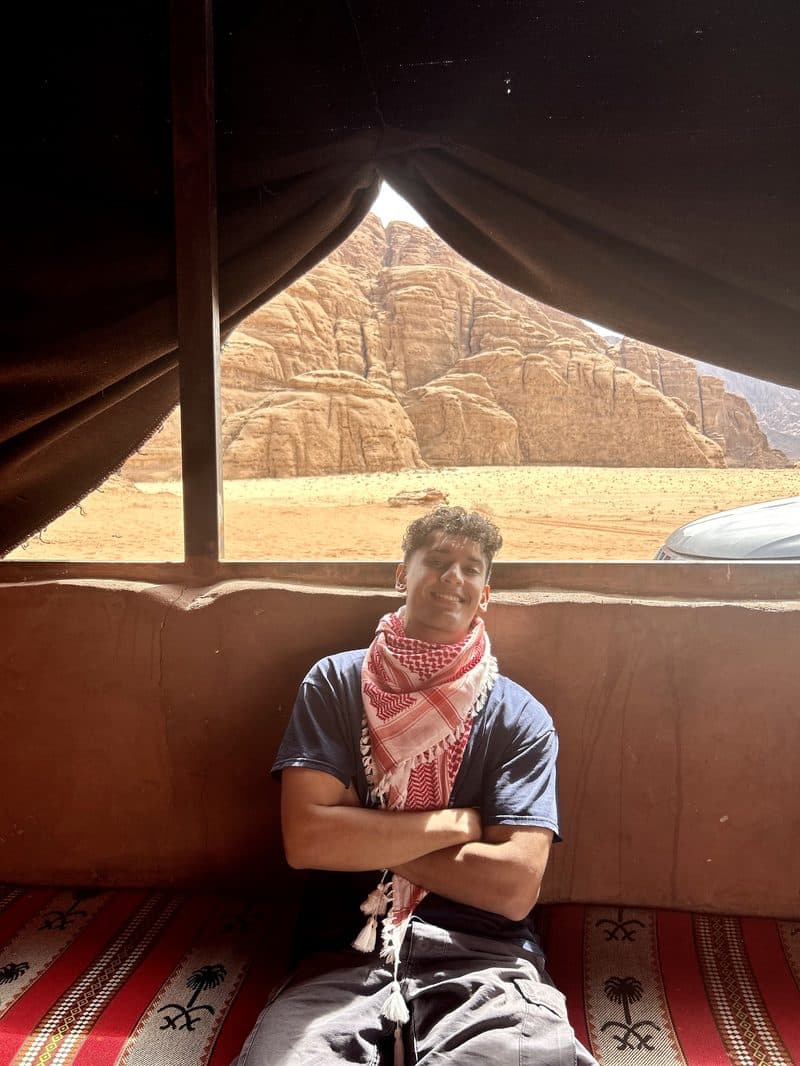
Wadi Rum, 2024
— Shazan